Mealybug Species List
Mealybug Species Included in This Key
Published by Ahmed et al. (2025)
- Antonina graminis (Maskell, 1897)
- Antonina pretiosa Ferris, 1953
- Antoninoides nortoni (Parrott & Cockerell, 1899)
- Antoninoides parrotti (Cockerell, 1903)
- Brevennia rehi (Lindinger, 1943)
- Chaetococcus bambusae (Maskell, 1893)
- Chnaurococcus trifolii (Forbes, 1885)
- Chorizococcus rostellum (Lobdell, 1930)
- Crisicoccus taxodii Kosztarab, 1996
- Delottococcus confusus (De Lotto, 1977)
- Distichlicoccus species Ferris, 1950
- Dysmicoccus boninsis (Kuwana, 1909)
- Dysmicoccus brevipes (Cockerell, 1893)
- Dysmicoccus difficilis (Lobdell, 1930)
- Dysmicoccus diodium (McConnell, 1941)
- Dysmicoccus grassii (Leonardi, 1913)
- Dysmicoccus mackenziei Beardsley, 1965
- Dysmicoccus milleri Kosztarab, 1996
- Dysmicoccus neobrevipes Beardsley, 1959
- Dysmicoccus radinovskyi Miller & Miller, 2002
- Dysmicoccus texensis (Tinsley, 1900)
- Ferrisia dasylirii (Cockerell, 1896)
- Ferrisia gilli Gullan, 2003
- Ferrisia malvastra (McDaniel, 1962)
- Ferrisia quaintancii (Tinsley, 1898)
- Ferrisia uzinuri Kaydan & Gullan, 2012
- Ferrisia virgata (Cockerell, 1893)
- Heterococcus raui Miller, 1975
- Hypogeococcus hamoni Miller, 1983
- Hypogeococcus margaretae Miller, 1983
- Hypogeococcus pungens Granara de Willink, 1981
- Leptococcus eugeniae (Miller & Denno, 1977)
- Maconellicoccus hirsutus (Green, 1908)
- Miscanthicoccus miscanthi (Takahashi, 1928)
- Nipaecoccus floridensis Beardsley, 2001
- Nipaecoccus nipae (Maskell, 1893)
- Nipaecoccus viridis (Newstead, 1894)
- Oracella acuta (Lobdell, 1930)
- Palmicultor browni (Williams, 1960)
- Palmicultor lumpurensis (Takahashi, 1951)
- Palmicultor palmarum (Ehrhorn, 1916)
- Paracoccus gillianae von Ellenrieder & Stocks, 2014
- Paracoccus herreni Williams & Granara de Willink, 1992
- Paracoccus juniperi (Ehrhorn, 1906)
- Paracoccus lycopersici Ezzat & McConnell, 1956
- Paracoccus marginatus Williams & Granara de Willink, 1992
- Paradoxococcus mcdanieli McKenzie, 1962
- Paraputo olivaceus (Cockerell, 1896)
- Phenacoccus madeirensis Green, 1923
- Phenacoccus miruku Tanaka & Choi, 2022
- Phenacoccus multicerarii Granara de Willink, 2007
- Phenacoccus parvus Morrison, 1924
- Phenacoccus solani Ferris, 1918
- Phenacoccus solenopsis Tinsley, 1898
- Planococcus citri (Risso, 1813)
- Planococcus minor (Maskell, 1897)
- Pseudantonina species Green, 1922
- Pseudococcus bryberia Gimpel & Miller, 1996
- Pseudococcus dendrobiorum Williams, 1985
- Pseudococcus dolichomelos Gimpel & Miller, 1996
- Pseudococcus elisae Borchsenius, 1947
- Pseudococcus importatus McKenzie, 1960
- Pseudococcus jackbeardsleyi Gimpel & Miller, 1996
- Pseudococcus landoi (Balachowsky, 1959)
- Pseudococcus longispinus (Targioni Tozzetti, 1867)
- Pseudococcus maritimus (Ehrhorn, 1900)
- Pseudococcus microcirculus McKenzie, 1960
- Pseudococcus nakaharai Gimpel & Miller, 1996
- Pseudococcus odermatti Miller & Williams, 1997
- Pseudococcus sorghiellus (Forbes, 1885)
- Pseudococcus spanocera Gimpel & Miller, 1996
- Pseudococcus viburni (Signoret, 1875)
- Pseudoferrisia floridana (Ferris, 1953)
- Saccharicoccus sacchari (Cockerell, 1895)
- Spilococcus mamillariae (Bouché, 1844)
- Stemmatomerinx acircula Howell & Miller, 1976
- Stemmatomerinx adenticulata Howell & Miller, 1976
- Syrmococcus spirapuncta (Lobdell, 1930)
- Tridiscus species Ferris, 1950
- Trionymus species Berg, 1899
- Vryburgia amaryllidis (Bouché, 1837)
- Vryburgia brevicruris (McKenzie, 1960)
- Vryburgia trionymoides (De Lotto, 1961)
* These four genera contain undescribed species found in Florida.
** These 12 species and three genera key out at two places in the key.
*** These genera include species that key out at two different locations.
**** Pseudantonina includes undescribed species and keys only to genus.
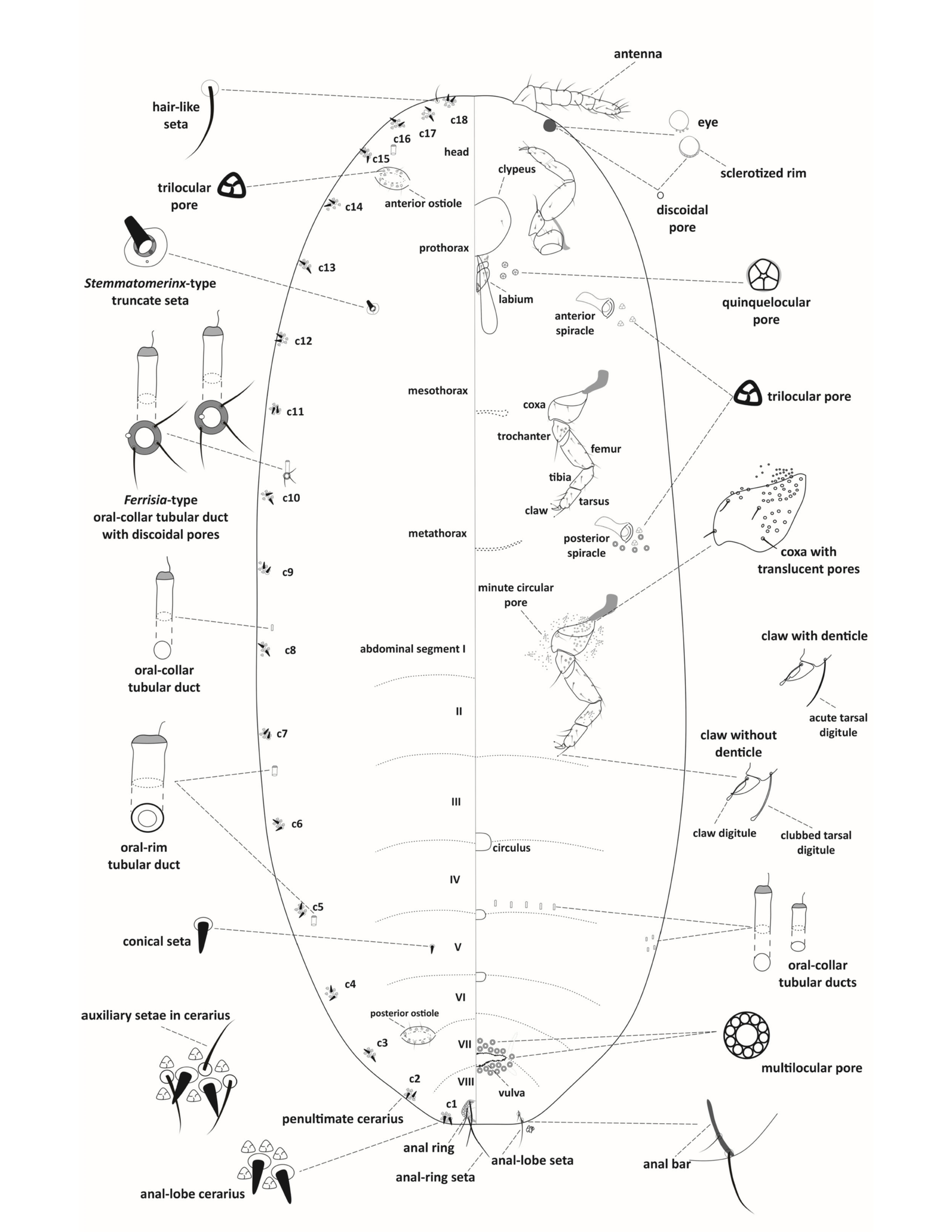
Generalized Mealybug Morphology
Figure 1: Morphological Structures of Pseudococcidae
Clickable Dichotomous Mealybug Key
3(2).
3A. Abdomen without sclerotized plates
3B. Abdomen with sclerotized plates
Antonina pretiosa Ferris
4(3).
4A. Anal ring invaginated, dorsal multilocular pores absent
4B. Anal ring not invaginated, dorsal multilocular pores present
Antoninoides nortoni (Parrott & Cockerell)
5(4).
5A. Without compact group of duct-like pores behind posterior spiracles;
ventral multilocular pores present on all abdominal segments
Antonina graminis (Maskell)
5B. With compact group of duct-like pores behind posterior spiracles;
ventral multilocular pores restricted to posterior 2 or 3 abdominal segments
Chaetococcus bambusae (Maskell)
6(2).
6A. Antennae geniculate; often with tri- or bitubular cerores (i.e., tri- or bitubular pores or ducts)
Rhizoecidae#
6B. Antennae not geniculate; without tri- or bitubular cerores (i.e., tri- or bitubular pores or ducts)
8(7).
8A. Coxa not enlarged, without translucent pores
Antoninoides parrotti (Cockerell)
8B. Coxa enlarged, with translucent pores
Pseudantonina Green (in part)
9(7).
9A. With pores in spiracular atrium
Syrmococcus spirapuncta (Lobdell)
9B. Without pores in spiracular atrium
Tridiscus Ferris (in part)
10(1).
10A. Number of cerarii fewer than 10 pairs
10B. Number of cerarii 10 pairs or more
11(10).
11A. With oral-rim tubular ducts (excluding Ferrisia-type oral-collar tubular ducts)
11B. Without oral-rim tubular ducts
13(12).
13A. With denticle on claw; with 2 pairs of cerarii
Vryburgia trionymoides (De Lotto)
13B. Without denticle on claw; with more than 2 pairs of cerarii
Maconellicoccus hirsutus (Green)
14(12).
14A. With more than 5 multilocular pores on venter
14B. Without or with fewer than 5 multilocular pores on venter
15(14).
15A. Translucent pores present on hind coxa
15B. Translucent pores absent from hind coxa
16(15).
16A. With translucent pores on hind tibia
16B. Without translucent pores on hind tibia
Chorizococcus rostellum (Lobdell)
17(16).
17A. Claw denticle absent; translucent pores scattered on hind tibia
17B. Claw denticle present; translucent pores in tight cluster on hind tibia
Spilococcus mamillariae (Bouché) (in part)
18(17).
18A. With fewer than 10 ventral oral-rim tubular ducts in medial and mediolateral area of thorax
18B. With 10 or more ventral oral-rim tubular ducts in medial and mediolateral area of thorax
Paracoccus gillianae von Ellenrieder & Stocks (in part)
19(18).
19A. With oral-rim tubular ducts on dorsum
Paracoccus lycopersici Ezzat & McConnell
19B. Without oral-rim tubular ducts on dorsum
Paracoccus juniperi (Ehrhorn) (in part)
20(15).
20A. Dorsal multilocular pores present; legs comparatively short and stout
Vryburgia brevicruris (McKenzie)
20B. Dorsal multilocular pores absent; legs comparatively large
Vryburgia amaryllidis (Bouché)
21(14).
21A. Ferrisia-type oral-collar tubular ducts present; anal-lobe cerarius with more than 2 conical setae
Pseudoferrisia floridana (Ferris)
21B. Ferrisia-type oral-collar tubular ducts absent; anal-lobe cerarius with 2 conical setae
Distichlicoccus Ferris
22(11).
22A. With 4 or fewer pairs of cerarii
22B. With more than 4 pairs of cerarii
23(22).
23A. With Ferrisia-type oral-collar tubular ducts
23B. Without Ferrisia-type oral-collar tubular ducts
25(24).
25A. Less than 10 Ferrisia-type oral-collar tubular ducts; without oral-collar tubular ducts along ventral margin
Ferrisia quaintancii (Tinsley) (in part)
25B. More than 10 Ferrisia-type oral-collar tubular ducts; with oral-collar tubular ducts along ventral margin
Ferrisia gilli Gullan
26(24).
26A. Multilocular pores present on abdominal segment VI
26B. Multilocular pores absent from abdominal segment VI
Ferrisia malvastra (McDaniel)
27(26).
27A. Ferrisia-type oral-collar tubular ducts with discoidal pores touching orifice of duct opening;
non-Ferrisia type oral-collar tubular ducts often with discoidal pores associated with opening
Ferrisia uzinuri Kaydan & Gullan
27B. With the following combinations of characters distinguishing
Ferrisia dasylirii and Ferrisia virgata (see comparison table below)
| Character | Ferrisia dasylirii (Cockerell) | Ferrisia virgata (Cockerell) |
|---|---|---|
| Discoidal pores associated with Ferrisia-type oral-collar tubular ducts | Protruding from sclerotized margin of duct opening | Not protruding; located in mid-area of sclerotization |
| Multilocular pores on abdominal segment VI | Usually fewer than 15 | Usually more than 15 |
| Translucent pores on hind coxa | Absent | Present |
| General diagnostic impression | Reduced pore counts; more protruding discoidal pores | More abundant pores; discoidal pores internal to margin |
30(29).
30A. Spiracles narrow and elongate
Tridiscus Ferris (in part)
30B. Spiracles broadly oval
Miscanthicoccus miscanthi (Takahashi)
31(29).
31A. With minute circular pores on derm surrounding each hind coxa
31B. Without minute circular pores on derm surrounding each hind coxa
32(31).
32A. With 1 pair of cerarii
Saccharicoccus sacchari (Cockerell)
32B. With 2 or more pairs of cerarii
Palmicultor lumpurensis (Takahashi) (in part)
33(31).
33A. Anterior pair of ostioles absent; body rotund; typically on Rhus L.
Ferrisia quaintancii (Tinsley) (in part)
33B. Anterior pair of ostioles present; body usually elongate; typically on grasses
Trionymus Berg (in part)
35(34).
35A. Translucent pores absent from hind coxa; antennae 6 or 7 segmented
Brevennia rehi (Lindinger)
35B. Translucent pores present on hind coxa; antennae 9 segmented
Heterococcus raui Miller
37(36).
37A. Coxa typical or slightly enlarged; without pores in atrium of spiracles
37B. With one or both of the following: coxa greatly enlarged; pores in atrium of spiracle
Pseudantonina Green (in part)
38(37).
38A. Body elongate; typically on grasses
Trionymus Berg (in part)
38B. Body rotund; typically not on grasses
Chnaurococcus trifolii (Forbes)
40(39).
40A. With 1 circulus
40B. With 2 or 3 circuli
Hypogeococcus pungens Granara de Willink
41(40).
41A. Setae on hind femur conical; some dorsal setae enlarged
Hypogeococcus margaretae Miller
41B. Setae on hind femur hair-like; dorsal setae not enlarged
Hypogeococcus hamoni Miller
42(39).
42A. Without conspicuous row of large ventral oral-collar tubular ducts on abdominal segment V; with circulus
42B. With conspicuous row of large ventral oral-collar tubular ducts on abdominal segment V; without circulus
Paradoxococcus mcdanieli McKenzie
43(42).
43A. Dorsal oral-collar tubular ducts absent
43B. Dorsal oral-collar tubular ducts present
44(43).
44A. Multilocular pores absent from dorsum; more than 2 conical setae in cerarii
Dysmicoccus difficilis (Lobdell) (in part)
44B. Multilocular pores present on dorsum; 2 conical setae in cerarii
Oracella acuta (Lobdell)
45(43).
45A. With minute circular pores on derm surrounding each hind coxa
Palmicultor lumpurensis (Takahashi) (in part)
45B. Without minute circular pores on derm surrounding each hind coxa
Dysmicoccus boninsis (Kuwana)
46(10).
46A. Without minute circular pores on derm surrounding each hind coxa
46B. With minute circular pores on derm surrounding each hind coxa
47(46).
47A. With auxiliary setae in cerarii anterior to anal-lobe cerarius
47B. Without auxiliary setae in cerarii anterior to anal-lobe cerarius
48(46).
48A. Usually more than 3 conical setae in anal-lobe cerarius; antennae usually 6 segmented, rarely 7 segmented
Palmicultor palmarum (Ehrhorn)
48B. Usually 2, rarely 3, conical setae in anal-lobe cerarius; antennae 7 or 8 segmented
Palmicultor browni (Williams)
50(49).
50A. Antennae with less than 9 segments; never with 16 pairs of cerarii
50B. Antennae 9 segmented; with 16 pairs of cerarii
Leptococcus eugeniae (Miller & Denno)
51(50).
51A. Multilocular pores restricted to vulvar area
51B. Multilocular pores not restricted to vulvar area
52(51).
52A. With more than 1 oral-rim tubular duct associated with each abdominal cerarius; anal-lobe and penultimate cerarii heavily sclerotized
Pseudococcus longispinus (Targioni Tozzetti)
52B. With 0–1 oral-rim tubular duct associated with each abdominal cerarius; anal-lobe cerarius heavily sclerotized, penultimate cerarius not heavily sclerotized
Pseudococcus dendrobiorum Williams
53(51).
53A. Translucent pores present on hind coxa
53B. Translucent pores absent from hind coxa
54(53).
54A. With 17 pairs of cerarii; oral-rim tubular ducts on dorsal submargin between cerarii 15 and 16 present or absent; dorsal oral-rim tubular ducts usually present near cerarii, mediolaterally and medially on abdominal segments (3–34 oral-rim tubular ducts on dorsum)
54B. With fewer than 17 pairs of cerarii; oral-rim tubular ducts on dorsal submargin between cerarii 15 and 16 (or their positions) absent; dorsal oral-rim tubular ducts usually present near cerarii, restricted to submargin, rarely present mediolaterally and medially on abdominal segments (0–13 oral-rim tubular ducts on dorsum)
Pseudococcus spanocera Gimpel & Miller
55(54).
55A. Total length of hind femur, tibia and tarsus less than 485 μm; antennae less than 365 μm in length; with relatively smaller circulus (31–87 μm in width)
Pseudococcus sorghiellus (Forbes)
55B. Total length of hind femur, tibia and tarsus more than 485 μm; antennae more than 365 μm in length; with relatively larger circulus (59–111 μm in width)
Pseudococcus dolichomelos Gimpel & Miller
56(53).
56A. Translucent pores present on hind tibia, absent from hind femur
56B. Translucent pores present on hind tibia and femur
57(56).
57A. Dorsal oral-collar tubular ducts absent; dorsal multilocular pores absent; hind tibia not swollen mesally; circulus ≤ 126 μm wide
57B. Dorsal oral-collar tubular ducts present; dorsal multilocular pores usually present (numbering 0–5); hind tibia swollen mesally; circulus ≥ 148 μm wide
Pseudococcus nakaharai Gimpel & Miller
58(57).
58A. Circulus large (75–126 μm wide); 4–21 ventral oral-collar tubular ducts mesad of cerarius 12
58B. Circulus small (22–74 μm wide); 0–3 ventral oral-collar tubular ducts mesad of cerarius 12
Pseudococcus microcirculus McKenzie
59(58).
59A. Oral-rim tubular duct(s) present near frontal cerarius (c17); with 0–5 discoidal pores in membranous area around each eye
Pseudococcus importatus McKenzie
59B. Oral-rim tubular duct(s) absent near frontal cerarius (c17); with 6–11 discoidal pores in sclerotized rim around each eye
Pseudococcus landoi (Balachowsky)
60(56).
60A. Discoidal pores present near eye, with discoidal pores associated with eye in sclerotized rim
60B. Discoidal pores absent near eye, or with discoidal pores associated with eye not in sclerotized rim
61(60).
61A. With combination of at least two of following characters: with 1–13 dorsal oral-rim tubular ducts on abdomen; more than 20 multilocular pores on abdominal segment IV; small rim associated with marginal oral-collar tubular ducts on thorax
Pseudococcus elisae Borchsenius
61B. With combination of at least two of following characters: with 14–27 dorsal oral-rim tubular ducts on abdomen; less than 15 multilocular pores on abdominal segment IV; no rim associated with marginal oral-collar tubular ducts on thorax
Pseudococcus jackbeardsleyi Gimpel & Miller
62(60).
62A. Without oral-rim tubular ducts on submargin between cerarii 15 and 16
62B. With oral-rim tubular ducts on submargin between cerarii 15 and 16
63(62).
63A. Discoidal pores near eye absent; small dorsal oral-collar tubular ducts present on meso- and/or metathorax in medial and mediolateral areas
Pseudococcus odermatti Miller & Williams
63B. Discoidal pores near eye present; without dorsal oral-collar tubular ducts
Pseudococcus viburni (Signoret)
64(62).
64A. With 0–2 ventral oral-collar tubular ducts on each side of head; with 2–11 ventral oral-collar tubular ducts mesad of cerarius 12
Pseudococcus bryberia Gimpel & Miller
64B. With 3–25 ventral oral-collar tubular ducts on each side of head; with 10–25 ventral oral-collar tubular ducts mesad of cerarius 12
Pseudococcus maritimus (Ehrhorn)
65(49).
65A. Majority of abdominal cerarii with 2 conical setae
65B. Majority of abdominal cerarii with more than 2 conical setae
66(65).
66A. Setae on dorsum of abdominal segment VIII about as long as other dorsal setae
66B. Cluster of setae on dorsum of abdominal segment VIII conspicuously longer than other dorsal setae
Dysmicoccus brevipes (Cockerell) (in part)
67(66).
67A. With more than 10 ventral oral-collar tubular ducts on margin and submargin of thorax
67B. Without oral-collar tubular ducts on margin and submargin of thorax or with less than 10
68(67).
68A. Without circulus, with 16 pairs of cerarii; without translucent pores on hind femur
Dysmicoccus milleri Kosztarab
68B. With circulus, with 17 pairs of cerarii; with translucent pores on hind femur
Dysmicoccus grassii (Leonardi)
70(69).
70A. Some dorsal setae conical; with less than 17 pairs of cerarii
70B. Dorsal setae hair-like; with 17 pairs of cerarii
Dysmicoccus texensis (Tinsley)
71(70).
71A. With 100 or more multilocular pores; cerarian setae separated by less than length of conical seta
Nipaecoccus floridensis Beardsley (in part)
71B. With 50 or fewer multilocular pores; cerarian setae separated by more than length of conical seta
Nipaecoccus nipae (Maskell) (in part)
72(69).
72A. With 9-segmented antennae
Dysmicoccus radinovskyi Miller & Miller
72B. With 8 or fewer antennal segments
Dysmicoccus diodium (McConnell)
73(65).
73A. Translucent pores absent from hind coxa
73B. Translucent pores present on hind coxa
Dysmicoccus mackenziei Beardsley
74(73).
74A. With 17 pairs of cerarii
74B. With less than 17 pairs of cerarii
Dysmicoccus difficilis (Lobdell) (in part)
75(73).
75A. Cluster of setae on dorsum of abdominal segment VIII conspicuously longer than other dorsal setae
Dysmicoccus brevipes (Cockerell) (in part)
75B. Setae on dorsum of abdominal segment VIII about as long as other dorsal setae
Dysmicoccus neobrevipes Beardsley
76(47).
76A. With Stemmatomerinx-type truncate setae on dorsum
76B. Without Stemmatomerinx-type truncate setae on dorsum
77(76).
77A. Without denticle on claw; with circulus
Stemmatomerinx adenticulata Howell & Miller
77B. With denticle on claw; without circulus
Stemmatomerinx acircula Howell & Miller
78(76).
78A. With dorsal multilocular pores
78B. Without dorsal multilocular pores
79(78).
79A. Dorsal multilocular pores in row across some abdominal segments
79B. Dorsal multilocular pores restricted to body margin
Phenacoccus miruku Tanaka & Choi (in part)
80(79).
80A. Quinquelocular pores absent on venter
Phenacoccus multicerarii Granara de Willink
80B. Quinquelocular pores present on venter
Phenacoccus madeirensis Green
81(78).
81A. Quinquelocular pores present on venter
81B. Quinquelocular pores absent on venter
82(81).
82A. Ventral multilocular pores absent from body margin
Phenacoccus parvus Morrison
82B. Ventral multilocular pores present near body margin
Phenacoccus miruku Tanaka & Choi (in part)
84(83).
84A. Oral-rim tubular ducts present near some abdominal cerarii (sometimes ventral only)
84B. Oral-rim tubular ducts absent
85(84).
85A. With translucent pores on hind tibia
85B. Without translucent pores on hind tibia
Paracoccus marginatus Williams & Granara de Willink
86(85).
86A. With translucent pores on hind coxa
86B. Without translucent pores on hind coxa
Delottococcus confusus (De Lotto) (in part)
87(86).
87A. With fewer than 10 ventral oral-rim tubular ducts in medial and mediolateral areas of thorax
87B. With 10 or more ventral oral-rim tubular ducts in medial and mediolateral area of thorax
Paracoccus gillianae von Ellenrieder & Stocks (in part)
88(87).
88A. With dorsal oral-rim tubular ducts
88B. Without dorsal oral-rim tubular ducts
Paracoccus juniperi (Ehrhorn) (in part)
89(88).
89A. With less than 5 oral-rim tubular ducts
Planococcus citri (Risso) (in part)
89B. With more than 5 oral-rim tubular ducts
Paracoccus herreni Williams & Granara de Willink
90(84).
90A. For rapid identification, the following characters will work most of time;
more than 4 oral-collar tubular ducts between antennae; more than 5 oral-collar tubular ducts
adjacent to middle pair of legs counting both sides of body
Planococcus citri (Risso) (in part)
90B. For rapid identification, the following characters will work most of time;
less than 5 oral-collar tubular ducts between antennae; less than 5 oral-collar tubular ducts
adjacent to middle pair of legs counting both sides of body
Planococcus minor (Maskell)
90C. For more accurate identification, use following table
[adapted from Cox (1989)], if score is 0–35 = Pl. minor and 36–120 = Pl. citri.
| Character | Value | Score |
|---|---|---|
| Total number of ventral oral-collar tubular ducts on both sides of head | 0–3 | 0 |
| 4–13 | 10 | |
| 14–35 | 40 | |
| Total number of ventral oral-collar tubular ducts laterad of both middle coxae | 0–2 | 0 |
| 3–7 | 10 | |
| 8–30 | 40 | |
| At least 1 ventral oral-collar tubular duct(s) between 16th and 17th cerarius (counting from anal lobe) | No | 0 |
| Yes | 10 | |
| Total number multilocular pores behind both front coxae | 0–6 | 5 |
| 7–12 | 0 | |
| Ratio length hind tibia + tarsus to length of trochanter + femur | 1.00–1.07 | 0 |
| 1.08–1.17 | 5 | |
| 1.18–1.30 | 10 | |
| Width of row of ventral multilocular disk pores on posterior margin of segment VI | Single | 15 |
| Intermediate | 5 | |
| Double | 0 |
92(91).
92A. Oral-rim tubular ducts absent; tarsal digitules with acute apex; tibia with translucent pores scattered
92B. Oral-rim tubular ducts present; tarsal digitules with clubbed apex; distal tibia with conspicuous cluster of translucent pores
Spilococcus mamillariae (Bouché) (in part)
93(92).
93A. Ventral multilocular pores on abdominal segment VII present in row along posterior edge only; circulus usually small, rounded; antennae usually 8 segmented
Phenacoccus solani Ferris
93B. Ventral multilocular pores on abdominal segment VII present between anterior and posterior margins; circulus usually large, more flaccid; antennae usually 9 segmented
Phenacoccus solenopsis Tinsley
95(94).
95A. Multilocular pores and oral-collar tubular ducts uncommon in marginal areas of thorax and abdomen
95B. Multilocular pores and oral-collar tubular ducts in dense band along body margin of thorax and abdomen
Nipaecoccus viridis (Newstead)
96(95).
96A. With 100 or more multilocular pores; cerarian setae separated by less than length of conical seta
Nipaecoccus floridensis Beardsley (in part)
96B. With 50 or fewer multilocular pores; cerarian setae separated by more than length of conical setae
Nipaecoccus nipae (Maskell) (in part)
97(94).
97A. Anal-lobe cerarii with 2 conical setae
Delottococcus confusus (De Lotto) (in part)
97B. Anal-lobe cerarii with more than 3 conical setae
Paraputo olivaceus (Cockerell)
Reference
Ahmed, M.Z., Powell, E.C. & Miller, D.R. (2025) ‘A taxonomic key to mealybugs (Hemiptera: Coccomorpha: Pseudococcidae) of Florida, United States’, Florida Entomologist, 108(s1), pp. 20240083. https://doi.org/10.1515/flaent-2024-0083